Showing posts with label asparagus recipes. Show all posts

14 June 2010

Chicken and Asparagus Stir Fry

I’m afraid this may be my last asparagus recipe for the season. (Sob!) I’ll keep eating asparagus, of course. But it is beginning to disappear from our local farm stands.

I’m always up for a stir fry. You can do the chopping in advance and just throw the thing together in minutes.

This recipe is flexible. You may add just about any vegetables you like. I’ve used peppers, water chestnuts, and broccoli. I just look in the refrigerator! And I don’t see why vegetarians couldn’t substitute tofu for the chicken.

You may also skip parboiling the asparagus and carrot pieces, but then you will have to cook this dish longer.

The Stir Fry

Ingredients:

for the marinade:


4 teaspoons low-sodium soy sauce
4 teaspoons dry sherry
2 teaspoons cornstarch
1 tablespoon canola or peanut oil

for the sauce:

6 tablespoons low-sodium soy sauce
2 tablespoons dry sherry
2 tablespoons rice vinegar
2 teaspoons sugar
1 teaspoon cornstarch paste (1 teaspoon cornstarch dissolved in a little water)

for the stir fry:

canola or peanut oil as needed for frying
2 boned, skinned chicken breasts, chopped into bite-sized pieces
crushed red pepper to taste (I used about 3/4 teaspoon)
1 large or 2 small green onions (mostly white part), finely chopped
2 garlic cloves, finely chopped
1/2 cup asparagus, chopped into bite-sized pieces and parboiled for 2 minutes
1 large carrot, cut into bite-sized pieces and parboiled for 2 minutes
a splash of sesame oil

Instructions:

Combine the marinade ingredients in a medium bowl. Combine the sauce ingredients in a small bowl. Add the chicken pieces to the marinade. Let them marinate for 15 minutes.

In a wok or heavy frying pan heat enough oil to lightly cover the bottom of the pan. When it the oil is hot drain the chicken (reserving the marinade) and lightly brown the pieces, stirring. Toss in the red pepper and stir briefly.

Remove the chicken from the pan or move it to the sides. Quickly add and stir fry the onion and garlic pieces for a minute or two; then add the remaining vegetables. Stir fry for 1 to 2 more minutes. Return the chicken to the pot, add the sauce and the reserved marinade, and cook until the sauce thickens slightly and has coated all of the food. (This shouldn’t take more than a couple of minutes.)

Remove the pan from the heat and toss in the sesame oil. Serve over rice.
Serves 4.


If you enjoyed this post, please consider taking out an email subscription to my blog. Just click on the link below!

Subscribe to In Our Grandmothers’ Kitchens by Email.

09 June 2010

Stockton Asparagus and Chicken Enchiladas

This creamy casserole comes from a small, gem-packed cookbook sent to me by the Stockton Asparagus Festival in Stockton, California. I think next time I may try spicing it up a little—or maybe not! My family ate every bite of it this way.

In my constant quest for spice I often forget that mild flavors can be appealing as well.

The original recipe called for 3 to 4 cups chicken broth. I used 4—and as you can see from the photo below my enchiladas were very wet! So I suggest sticking to 3………

Have fun!


Asparagus and Chicken Enchiladas

Ingredients:

2 pounds asparagus, cut into 1-inch pieces
12 tortillas (I used flour)
oil as needed for softening tortillas
1/2 cup (1 stick) sweet butter
1/2 cup flour
3 cups chicken broth
1 cup sour cream
1/2 cup salsa verde (a little more if you like)
3 cups (generous) grated cheese—Monterery Jack or sharp cheddar or a mixture of the 2
2-1/2 to 3 cups cooked, shredded chicken
1/2 cup chopped onions

Instructions:

Blanch the asparagus for 2 minutes. Cool them with ice cubes and drain them; set them aside.

Preheat the oven to 425 degrees.

Cook each tortilla briefly on both sides in an oiled skillet until it softens. Set the tortillas aside to drain and cool.

In a saucepan melt the butter. Whisk in the flour for a minute; then whisk in the broth. Cook until thick and bubbly, stirring constantly.

Add the sour cream and salsa; heat thoroughly. Remove from heat.

Mix together 2 cups of the cheese, the chicken, the onion pieces, and the asparagus. Divide this mixture evenly among the tortillas, and top each with 3 tablespoons of sauce.

Roll up the tortillas and place them, seam-side down, in a 9-by-13-inch baking dish. Sprinkle with the remaining sauce and cheese.

Bake for 25 minutes. Serves 6.


If you enjoyed this post, please consider taking out an email subscription to my blog. Just click on the link below!


04 June 2010

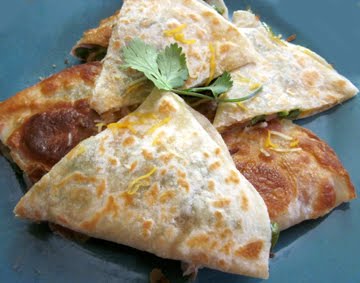
Asparagus Quesadillas

Recently I made a batch of tasty asparagus enchiladas. It’s been so hot lately that I don’t have the heart to post the recipe, however! Presumably we’ll have a cooler spell before summer sets in permanently.

In the meantime, here’s a recipe that doesn’t involve turning on the oven. It’s easy to boot. And it’s extremely toothsome.

I recommend it with all the options, but one of my tasters felt the Prosciutto was out of place (too Italian for a southwestern sandwich) so I am exercising caution in my recipe writing.


Asparadillas

Ingredients:

canola or peanut oil as needed for light frying
1/4 red onion, thinly sliced
1/2 pound asparagus, cut into 1-inch pieces and blanched for 1 minute
lots of freshly ground pepper
4 small flour tortillas
1/2 to 1-1/2 cups grated cheese (cheddar, Monterey Jack, or a blend)
4 slices Prosciutto (optional but good)
chopped cilantro to taste (ditto)

Instructions:

In a small saucepan heat a small amount of oil and sauté the slices of onion until they brown around the edges—about 10 minutes over low to medium heat. Stir in the asparagus, and toss for a minute or two. Grind pepper over the combination and toss again. Remove from heat.

In a larger pan or griddle place a small amount of additional oil and let it heat up. Place the first tortilla in the oil, let it heat for just a moment, and then flip it over. Toss on cheese to taste plus a quarter of the asparagus mixture.

At this point you may add a slice of Prosciutto (for a sort of Italian-American quesadilla) or a little cilantro (for a more Mexican-American quesadilla). Or you may leave well enough alone.

Fold the tortilla in half to seal the quesadilla, and make sure it is brown on both sides.

Remove it from heat and keep it warm while you repeat the process with the remaining tortillas.
Serves 4.


If you enjoyed this post, please consider taking out an email subscription to my blog. Just click on the link below!

Subscribe to In Our Grandmothers’ Kitchens by Email.


29 May 2010

What's a Nice Vegetable Like You Doing in a Batter Like This? or Tinky's Asparagus Fritters

I am working on a recipe for rhubarb catsup, which I thought would be just wonderful for Memorial Day weekend. I pictured it on a nice grilled burger on top of a red, white, and blue plate.

Alas, the catsup is still a work in progress. So I’m giving you a recipe that isn’t really a holiday recipe—or maybe it is. It certainly isn’t an everyday recipe since it manages to take a healthy seasonal food (asparagus) and make it into something really, really, really, really fattening.

And really, really, really REALLY delicious.


Tinky’s Asparagus Fritters

Ingredients:

1 pound asparagus
2 cups flour, divided
1 teaspoon baking powder
1 teaspoon salt
freshly ground pepper to taste
2 teaspoons lemon zest
1/2 cup freshly grated Parmesan cheese
1 cup beer
1 egg
peanut or canola oil as needed for frying
lemon wedges
coarse salt (optional)

Instructions:

Preheat the oven to 200 degrees.

Wash and trim the asparagus spears, and cut them into small pieces—between 1 and 2 inches long.

Pop the pieces of asparagus into boiling water. Return the water to the boil, and cook the asparagus for 1 more minute. Drain the pieces in a colander with ice so that they will stop cooking immediately.

In a bowl thoroughly combine 1 cup of the flour, the baking powder, the salt, the pepper, the lemon zest, and the cheese.

Whisk together the beer and the egg. Stir this liquid mixture into the flour mixture. (A few lumps are just fine.)

Place the remaining cup of flour in a small bowl.

Pour oil into a frying pan until it is about 1 inch deep. Heat the oil until it is about 350 degrees.

Dredge each piece of asparagus in the small bowl of flour; then dip it into the liquid fritter batter so that it is coated.


Pop each fritter into the oil and cook it quickly, turning as needed, until it is golden brown. Do not crowd the fritters in the pan!

(Don’t worry if the flour and batter don’t adhere perfectly to the asparagus spears. A little green peeking out of the batter looks attractive. And don’t worry if your fritters are oddly shaped. Each one will have its own personality, and that will be just fine.)

When individual fritters are ready drain them on paper towels and store them in the warm oven until all the fritters have been cooked. You may end up with a little extra asparagus if you run out of batter or just get tired of cooking. Use this in a salad or a stir fry.

Serve with lemon wedges so that your guests can sprinkle a little juice on their fritters. They may add a little coarse salt for extra zing if they wish. (I wish!)

Serves 4 to 6.

If you enjoyed this post, please consider taking out an email subscription to my blog. Just click on the link below!

Subscribe to In Our Grandmothers’ Kitchens by Email.

22 May 2010

Asparagus Refrigerator Pickles


I know I’ve mentioned this before on these pages, but it bears repeating at this wonderful time of year:

I could eat asparagus every single day of my life!

It’s my favorite vegetable—pretty, crunchy, sweet, and versatile. I’m always trying to think up new ways to use it.

I love dill refrigerator pickles made with cucumber so a few days ago I decided to try something similar with a bunch of fresh asparagus I found at a farm stand.

My mother, whose tastes become sweeter and sweeter as she grows older, found my pickles a little tart. I thought they were refreshing.

My only complaint was that they could have been crisper. They had more or less the consistency of cooked asparagus—cooked al dente, but cooked nevertheless.

Next time I’ll probably try just pouring warm brine over them instead of pre-cooking them. (I’ll let you know how this turns out!)

Meanwhile, I recommend them as they are. After a few days the vinegar turns the asparagus buds a gentle and pleasing pink.


Ingredients:

1 pound fresh, local asparagus spears
1 cup water
1/2 cup white vinegar
1-1/2 teaspoons kosher salt
1 pinch sugar
2 cloves garlic
1 generous branch dill
a few whole peppercorns

Instructions:

Clean and sterilize a pint jar. (A wide-mouth jar is best as it is easiest to stuff.)

Snap the asparagus spears where they break naturally. Discard the part of the spear that has fallen below the break.

Combine the water, vinegar, salt, and sugar in a nonreactive saucepan and bring them to a boil. Set the mixture aside to cool completely.

Wash the spears, and trim them so that they will fit into your jar. Save the extra bits of asparagus for salad, pasta, or stir-fry dishes.

Immerse the spears in boiling water. Return the water to a full boil and boil for1 minute. Rinse immediately and completely in very cold water to stop the spears from cooking further and drain them.

When the vinegar mixture is cool place the garlic, dill, pepper, and asparagus spears in the sterilized jar. Pour the vinegar mixture over them.

You should have about the right amount of liquid. If you need a little more, pour a little tap water into the jar to fill it to the top; then cover and gently shake the mixture.

If you don’t need to add water, just cover the jar. Refrigerate the pickles for 3 to 4 days before eating. Makes 1 pint.

If you enjoyed this post, please consider taking out an email subscription to my blog. Just click on the link below!

Subscribe to In Our Grandmothers' Kitchens by Email.


29 March 2010

Matzo Mania

Passover begins tonight. This eight-day holiday means many things to many people: the survival of the Jewish people in the book of Exodus, the overall history of Judaism, and even the last supper of Jesus.

For me, it’s a time to remember my Jewish relatives–particularly my grandparents, whom we always joined for Passover when I was a child.

As a food writer, I appreciate the way the whole holiday is structured around food. Each thing eaten at the Seder has its own meaning. In addition, the practice of eating no bread other than unleavened matzo during Passover commemorates the departure of the Jews from Egypt. Their bread didn’t have time to rise.

It is also a sort of penance. Eating matzo, pretty much the plainest of breads imaginable, reminds Jews of the trials of their forebears.

My grandmother served matzo without much adornment during Passover, occasionally sprucing it up with a little whipped cream cheese for breakfast or lunch.

Despite this tradition, I’m always tickled by the idea of getting a little fancier with matzo.

This year I have made two simple “matzo plus” dishes I’d like to share with you.

The first is Matzo Pizza. I got this idea from the website Kosher.com. Kosher.com’s resident chef, Jamie Geller, created a tasty standard pizza with her matzo—vegetables, cheese, tomato sauce.

I’m not such a fan of tomato-based pizza that I can’t wait eight days to have it. I do love asparagus, however. I’m a sucker for the asparagus pizza served in spring at the Green Emporium in Colrain, Massachusetts.

That pizza inspired this one. Matzo will never replace yeast crusts in my kitchen year round, but during Passover (or when one is in a hurry) it makes an acceptable, crispy platform for cheese and vegetables.

My second recipe today is a treat I’ve enjoyed for years when made by other people, Matzo Crunch. (Beware: many call it Matzo Crack because of its highly addictive properties!)

Marcy Goldman of BetterBaking.com invented this confection, which I have adapted a little. I have seen it covered with nuts (pressed into the chocolate when you sprinkle the optional salt). My friend Lark Fleury even makes it during other times of year with saltine crackers.

Marcy maintains that you can make the crunch with margarine if you keep kosher and want to eat it with meat. I think the butter adds so much flavor that I would advise you NOT to try the margarine. Just don’t eat the crunch with a meat meal!

Whenever and however you make it, I advise you to make sure that you have lots of people to whom you can give the crunch. It really is addictive—and very, very rich. I love to make it—and I love to get it out of the house FAST.

Happy Passover……


Springtime Matzo Pizza

Ingredients:

10 thin asparagus spears, trimmed and cut into 1-1/2-inch pieces
a splash of extra-virgin olive oil
3 basil leaves, torn into pieces
a sprinkle of red pepper flakes
1 teaspoon lemon zest
1/2 cup pitted ripe olives, cut into small rings
1/3 cup feta cheese, crumbled
1-1/2 matzos (the whole matzo should be halved for easier serving so that you have three halves)
3/4 cup mozzarella cheese, shredded

Instructions:

Preheat the oven to 375 degrees. Line a cookie sheet with aluminum foil, and lightly oil the foil.

Sauté the asparagus in the olive oil for 5 minutes. Remove from heat.

Stir in the basil, red pepper flakes, and lemon zest; then toss in the ripe olives and feta.

Place the three halves of matzo on the prepared cookie sheet, making sure that they fit together as well as possible. Sprinkle most of the mozzarella cheese on top of the matzo.

Spread the asparagus mixture over the cheese, and top with a little more mozzarella. Bake for 10 minutes, or until the cheese melts nicely.

Serves 1 for dinner or 2 to 3 for lunch.

Matzo Crunch

Ingredients:

6 pieces matzo, broken into several strips each
1 cup (2 sticks) unsalted butter
1 cup firmly packed brown sugar
1/2 teaspoon vanilla
1-1/2 cups chocolate chips (semi-sweet, white, or some of each—even milk if you like, and I like)
coarse sea salt for sprinkling (optional but yummy)

Instructions:

Preheat the oven to 350 degrees. Line 2 cookie sheets with aluminum foil, and place parchment paper or silicone mats over the foil. Place the pieces of matzo on top.

In a medium saucepan combine the butter and brown sugar. Bring them to a boil, stirring constantly. Boil for 3 minutes. Remove the mixture from the heat and stir in the vanilla.

Spoon the sugar mixture over the matzo, spreading it with a spatula to cover the matzo as well as you can. Bake for 15 minutes.

Remove the matzo from the oven and sprinkle the chocolate chips on top. After 5 minutes, spread the chocolate with a knife. Sprinkle a little sea salt on top if you wish for additional crunch and flavor.

Allow the crunch to cool; then break it into more pieces. Makes about 40 small pieces. Don’t forget to give most of them away!


If you enjoyed this post, please consider taking out an email subscription to my blog. Just click on the link below!
Subscribe to In Our Grandmothers' Kitchens by Email

22 May 2009

Taffy's Asparagus Penne

My Sad Asparagus Patch


Here is one more asparagus treat, perfect for the weird miscellaneous stalks that come up in my alleged garden every year. (I know that they would be healthier if I actually weeded the bed, but weeding has never been my specialty.) Since I cut the stalks into small pieces they don’t have to match in any way.

My family served this to my mother Jan (a.k.a. Taffy because she likes to swim in salt water) for Mother’s Day one year. It has become a May staple for us.

Cousin Jane (left) and Sister Leigh present the Penne to Taffy.


Ingredients:

1 pound penne
2 pounds fresh asparagus, washed, trimmed, and cut into bite-size pieces
1/2 cup extra virgin olive oil (plus a bit more if you like)
10 large cloves of garlic cut lengthwise into thin pieces
freshly ground pepper to taste
1/2 teaspoon salt (optional—if you put lots of salt in the penne and asparagus water you won’t need it) 1/4 cup (1/2 stick) sweet butter
1/2 pound Prosciutto, thinly sliced and then shredded (optional) freshly grated Italian cheese (such as Parmesan or Pecorino Romano) to taste—at least 1 cup, and maybe more
1 handful fresh parsley, finely chopped

Directions:

First, cook the penne according to the package instructions. When it is cooked al dente drain it, rinse it in cold water to cool it off, and drain it again.

While the pasta is cooking, place the asparagus in boiling water, and boil for 2 minutes. Carefully drain the asparagus, rinse it with very cold water, and drain it again.

When the pasta is ready and drained, pour the oil into a LARGE skillet, and let it heat over medium heat for about a minute, until it begins to shimmer. The oil will be very hot. Carefully add the pieces of garlic to the oil and cook, stirring vigorously, until the garlic begins to brown. (This won’t take long.)

Add the asparagus, salt (if needed), and pepper to the garlic. Cook for another 2 minutes, shaking or stirring gently. Add the pasta and the butter and cook until the vegetables and pasta are hot and well mixed, 3 to 4 minutes. Turn off the heat, and toss in the Prosciutto.

Carefully transfer the mixture to a serving bowl, and toss in lots of Parmesan cheese. Sprinkle the chopped parsley on top. Serve it to your mother and other guests immediately. Serves 8.

19 May 2009

Eggs Beatrice


Here’s another recipe for my beloved Sparrow Grass–or perhaps I should say Spearage, which according to Kathleen Wall at Plimoth Plantation was a common 17th-century term for asparagus.

I’m not a big Eggs Benedict Girl—the consistency of the ham never seems to me to go with the rest of the ingredients—but alter the recipe a little and incorporate asparagus and I’m hooked. (You may of course add ham as well!)

I’m always a little cautious about poaching eggs, but I found a helpful new product at the Lamson & Goodnow retail store in Shelburne Falls, Massachusetts, that banishes my fears. It’s called an eggshell™ and comes in packages of two that look like little cracked eggs.

To use one of these silicone products, lightly grease the inside, pop your egg into it, and float the eggshell in boiling water. Cover the pot, and cook for 5 minutes. Your poached egg pops easily out of the silicone and onto your English muffin.

Ingredients:

for the Hollandaise sauce (makes about 1 cup of sauce):

1/2 cup (1 stick) sweet butter
3 egg yolks
the juice of 1/2 small lemon
2 tablespoons hot water
a pinch of cayenne pepper
a pinch of salt

for assembly (per person):

1/2 English muffin
butter as needed for the muffins
1 slice Prosciutto (optional)
3 spears cooked asparagus (either whole or cut up)
1 poached egg
a generous dollop of Hollandaise sauce
salt and pepper to taste

Instructions:

First, make the Hollandaise sauce. Melt the butter in a saucepan. In the top of a double boiler over warm (but not boiling!) water, whisk the egg yolks until they are smooth. Whisk in the lemon juice. Slowly whisk in the butter in a thin stream.

Slowly stir in the hot water, cayenne, and salt, and cook for 1 minute more, whisking constantly. Set the sauce aside while you poach the eggs and cook the toast.

For each person, butter half of a toasted English muffin, and lay the Prosciutto on top if you want to use it. Depending on your preference, put the asparagus on next or the egg (my mother and I liked it both ways!).

Cover with a little Hollandaise sauce, and season to taste. Serve immediately. One recipe of Hollandaise makes enough sauce for 4 to 6 eggs.


The Eggshells


15 May 2009

Sparrow Grass

When I’m asked one of those silly hypothetical food questions—“What one food would you want to eat on a desert island?” or “What would you choose to eat for your last meal on death row?’’—I never have trouble making a decision. I’m an asparagus girl to the end.

Of course, asparagus is a cool-climate vegetable so it’s unlikely to grow on a desert island. And a prison chef would probably cook it until it was soggy. Nevertheless, I could eat even poorly cooked asparagus every day and be reasonably happy.

This time of year my favorite green vegetable is everywhere in the Pioneer Valley. As David Nussbaum recalled in Saveur magazine a few years ago, the Connecticut River Valley was the world’s asparagus capital between the 1930s and the 1970s.

Hadley Grass, as it was called, was shipped throughout the northeast and occasionally even overseas, where it was purportedly enjoyed by the Royal Family at Buckingham Palace.

When a blight hit the crop in the mid-1970s, Nussbaum wrote, asparagus in the area was hard hit. It took a while to find a blight-resistant strain, and many farmers moved on. Today it is mainly we locals who enjoy what remains of this formerly dominant crop.

Many western Massachusetts asparagus fans still use the term Hadley Grass, adapted from a popular nickname for the vegetable in the 1700s and 1800s, “sparrow grass.” Lexicographer John Walker wrote in 1791, “Sparrow-grass is so general that asparagus has an air of stiffness and pedantry.”

I was seven when I first tasted freshly picked asparagus. My family was visiting one of my father’s graduate-school professors in Wisconsin. Like many Midwesterners the professor and his wife had a huge garden.

When I took my first bite of fresh-from-the-garden asparagus I was amazed at the flavor and texture. It tasted more like butter than any vegetable should. I kept eating—and eating—and eating.

I haven’t consumed that much asparagus at one sitting since then, but I still remember that visit with pleasure. And I celebrate asparagus season every year. One of my yearly ambitions (one spring I’ll fulfill it!) is to taste a unique asparagus treat served about an hour away from me.

A fabulous dairy in Hadley, Massachusetts, Flayvors of Cook Farm, makes asparagus ice cream at this time of year. I haven’t tried it myself, but every other flavor I’ve tried there has been freshly made and imaginatively conceived.

Every summer when we take my nephew Michael on his annual pilgrimage to the Eric Carle Museum we end up indulging ourselves at Cook Farm on the way home.

Just to get you going on your own asparagus journey I’ll be posting a few sparrow grass recipes, starting with this easy roasted grass formula. Don’t feel that you have to use any of them, however. Nothing beats this vegetable simply steamed or boiled, topped with a little butter and/or lemon juice.

Roasted Asparagus

Ingredients:

1 pound asparagus, washed and trimmed
a generous splash of extra-virgin olive oil
salt and pepper to taste
1 handful feta cheese (optional)
2 tablespoons chopped fresh chives (optional)

Instructions:

Preheat the oven to 400 degrees. In an ovenproof dish, toss together the asparagus, oil, salt, and pepper. Lay the oiled asparagus in the dish in a single layer.

Bake the asparagus for 6 to 10 minutes (depending on its thickness; I had fairly thick asparagus so I used the full 10 minutes), turning once.

If you want to use the feta, lay it on top of the asparagus after turning. It won’t melt, but it will become warm and soft.

Remove the roasted asparagus from the oven, and garnish it with chives if desired. Serves 3 to 4.

Mother Jan is happy that Sparrow Grass season is here.