29 January 2014

Souper Bowl of Dip (with Chips!)


I have a confession to make. I have always had a weakness for dip made with packaged onion-soup mix. When I was little and my mother made it (very occasionally, I must add) it seemed like a miracle that all that flavor could come out of one small package stirred into some sour cream.

As a grownup I’m more skeptical about packaged foods than I was as a child, when they were a novelty. And I have to shudder when I read the side of an onion-soup package. I don’t really think a creamy dip needs things like partially hydrogenated soybean oil, caramel color, corn syrup, and disodium inosinate. I don’t know what that last item is—and neither does my computer’s spelling program—but I’m pretty sure it’s not what one could call a food, let alone a healthy food.

I do still love onion dip, however. And it’s an easy, tasty snack for the Big Game—or the “Superb Owl,” as The Colbert Report calls it since the NFL threatens to sue anyone else who uses the official terminology.

As this football event approaches I am concocting a more natural version of my childhood guilty pleasure. This dip starts with the base my mother used for her cordon bleu French onion soup—caramelized onions, mustard, and wine. She used red wine, but I was darned if I was going to open a bottle of wine for the minuscule amount I wanted so I used sherry. If you feel like drinking red wine, by all means substitute it for the sherry.

I can see adding additional ingredients another time—a little Creole seasoning for kick, some herbs (parsley? dill? thyme?), and/or a few drops of Worcestershire sauce. On Sunday as I watch the Broncos and the Seahawks battle it out, however, I plan to serve it just as it is below. This onion-dip recipe takes a little more time than the package-based version, but it’s by no means difficult. The resulting spread tastes fresh yet mellow, and highly satisfying—like French onion soup on a chip.

It tastes best with homemade vegetable chips. We made sweet-potato chips yesterday. I won’t tell the Culinary Recording Angel if you go out and buy some, however.

Mustard is added to caramelizing onions.

French Onion Dip

Ingredients:

2 teaspoons butter
1 tablespoon extra-virgin olive oil
2 large onions, cut into thin slices (my slices could have been thinner!), with each slice cut in half
1/2 teaspoon Dijon mustard (I used mustard with a little garlic, which lent a lovely flavor)
1 tablespoon dry sherry
salt and pepper to taste (I used about 3/4 teaspoon sea salt and three grinds of the pepper mill)
1-1/2 cups sour cream (half of this could be Greek yogurt if you want to be healthier)

Instructions:

The dip is best prepared early in the day or the night before you wish to serve it. It needs time in the refrigerator to let its flavors blend and mature.

Combine the butter and olive oil in a nonstick skillet over medium-low heat. When the butter melts stir in the onion slices. Cook them slowly, stirring every 5 minutes or so, until they are reduced and turn a lovely golden brown. This will take at least 1/2 hour and may take as long as an hour.

When the onions are almost ready stir in the mustard, and continue to cook, stirring, for at least five minutes. Add the sherry and cook, stirring, until the liquid disappears.

Sprinkle salt and pepper over the onions and remove them from the heat. Allow them to cool to room temperature. If you want to avoid having strings of onion in your dip, chop them a bit once they have cooled.

Put the onions and sour cream in the bowl of an electric mixer and stir briskly to combine.

Place the dip in the refrigerator, covered, and let the flavors combine for several hours. At least an hour before serving taste it on a neutral cracker to see whether you want to add any additional flavors (more salt and pepper perhaps?). Bring the dip to room temperature, and serve it with vegetable chips.

Makes about 2 cups.


Cold-Oil Sweet Potato Chips

My sister-in-law Leigh and I actually made two kinds of chips to go with our test dip—one batch fried and one batch baked. HOWEVER, I’m only giving you the recipe for the fried batch because we were so busy eating the fried chips (they were AWFULLY tasty) that I forgot to time the baked ones. They are obviously healthier than the fried version.

I’ll tell you how we did the baked ones, but I won’t officially publish the recipe until I make them again! Basically, one slices the sweet potatoes just as one does below for the fried chips. One combines extra-virgin olive oil (about 1 tablespoon) and sea salt (about 1/2 teaspoon) in a bowl; then one stirs in the slices of sweet potato until all are coated with a tiny bit of oil. The slices go on cookie sheets in a preheated oven (325-ish) until they finish cooking; I THINK this is about half an hour. One should stir/turn the potatoes after 10 minutes and check on them frequently.

Now for the FRIED version. Leigh has a mandoline slicer, which made creating the chips a breeze. I got the idea for cold-oil frying the chips from my friend Devany Vickery-Davidson in Charleston, South Carolina. Apparently, cold-oil frying is very chic, but I had never heard of it until Devany wrote about making French fries this way. It is less messy than hot-oil frying and a lot simpler.

Leigh works her mandoline magic.

The Chips

Ingredients:

1 sweet potato, peeled and sliced thinly
canola oil at room temperature as needed
sea salt as needed

Instructions:

Place the pieces of sweet potato in a deep, heavy skillet or saucepan. Spread them out as much as you can. Cover them with oil; then add a little more oil. Place the pan on medium heat. Stay by the stove.

In a few minutes the oil will begin to bubble. Stir the potato pieces a bit and keep heating them. As the potatoes cook stir them every minute or two to keep them from sticking together—and to monitor them. In a very few minutes they will brown and crisp up very quickly.

Use a skimmer or tongs to remove the chips from the oil. (Don’t forget to turn off the stove!) Drain them on paper towels, and sprinkle salt on top.

Let the chips cool for a couple of minutes; then serve them with dip. Makes about 20 chips. (The number depends on the thickness of your slicing.)

23 December 2013

Pumpkin Puffs

A while back I wrote about the ways in which cooking and music can both be viewed as folk practices. We start with a melody (or a recipe) that has been handed down for generations and put our own little tweak on it, allowing it to evolve.

As Christmas approaches and we’re surrounded by holiday music, I’m struck by another way in which cooking and music resemble each other.

My neighbor Alice Parker, a composer and conductor who excels at getting groups of people to sing with all their hearts (even if they don’t think they can sing!), often exhorts her singers to leave the notes on the page behind.

Music, she says, isn’t notes on a page. It’s what fills a room when singers and instrumentalists lift their eyes off that page and start interpreting the emotions behind the notes.

Music is something concrete plus a group of people coming together plus a little bit of magic.

That description also applies to cooking—particularly at this time of year, when we frequently cook alongside our families and neighbors.

This recipe came together in a group. My apartment complex in Virginia hosts cooking demonstrations from time to time. We thought it might be fun to try a holiday cookie swap. It took place last weekend. Community members brought their own cookies and recipes. As they munched and we talked I threw together a couple of batches of cookies (including my seasonal illumination cookies).

I naturally wanted to try baking something new … or at least new-ish. Those of you who read a lot of my writing will recognize the concoction below as a combination of two formulas: a basic pumpkin pie and the cranberry cream puffs I made a couple of years ago.

I wasn’t sure it would work, but it seemed worth trying. Luckily, I had lots of help filling the puffs from my fellow apartment dwellers.

(I wish I had photos of the event, but we were too busy cooking to remember to take them! I did take one of the final product and one of the filling.)

In end, we decided that this “new” holiday recipe was a definite keeper. So I offer it to you, along with my wishes for a delicious Christmas and a healthy, happy, peaceful new year.


Pumpkin Cream Puffs

I know it sounds as though this recipe has a LOT of steps. You can do much of the preparation in advance however. The custard may be done the day before and refrigerated. Ditto the caramel sauce (and you can always skip that and just dust a little confectioner’s sugar on top of your puffs).

Even the cream puffs can be made in advance and frozen for a day or two. Refresh them by baking them, lightly covered with foil, at 350 degrees for 10 minutes. If you prefer to purchase frozen cream-puff shells, feel free to do so. The filling is the important part of the recipe.

Ingredients:

for the custard:

1-1/2 cups pumpkin or winter squash puree
1/2 cup white sugar
1/2 cup brown sugar, firmly packed
1 teaspoon cinnamon
1/2 teaspoon salt
1/2 teaspoon ginger or allspice (or a bit of each)
1 cup evaporated milk
1/2 cup water
2 eggs

for the cream puffs:

1 cup water
1/2 cup (1 stick) sweet butter
1-1/4 cups flour
1/4 teaspoon salt
4 large eggs at room temperature (place them in warm water for a few minutes to achieve the right temperature)

for the optional caramel sauce:

1 cup sugar
1 cup heavy cream
1 teaspoon sea salt or kosher salt
2 teaspoons vanilla

for the filling:

2 cups heavy cream
confectioner’s sugar and vanilla to taste (we used about 2 tablespoons sugar—maybe a little more—and 2 teaspoons vanilla)


Instructions:

for the custard:

Make the custard early—ideally the day before—so it will have plenty of time to cool.

Preheat the oven to 425 degrees and grease a 9-inch pie dish. Combine the custard ingredients, and place them in the pie dish. Bake for 10 minutes; then reduce the heat to 350 degrees and bake for another 30 to 40 minutes, or until firm. Allow the custard to cool to room temperature; then cover it and refrigerate it until you are ready to assemble the puffs.

for the optional but good caramel sauce:

In a heavy, wide-bottom pan that holds at least 2 quarts slowly melt the sugar over medium-low heat. You may push the sugar in from the edges with a heavy spoon or heat-resistant spatula, and you may shake the pan over the heat. Try to avoid stirring the sugar, however. Be very careful; melting sugar can be extremely hot.

When the sugar has melted and turned a lovely caramel brown, remove it from the heat and whisk in half of the cream, followed by the other half plus the salt and vanilla. The sauce will bubble furiously.

If for some reason the sauce seizes (that is, the sugar hardens and doesn’t get absorbed by the cream), put it back over low heat until the sugar melts. Set the sauce aside. If you are making it in advance, cover and refrigerate it when it gets to room temperature so that it will last until you are ready to use it.

for the puffs:

Preheat the oven to 375 degrees. Lightly grease two cookie sheets or line them with silicone.

In a medium saucepan bring the water, butter, and salt to a rolling boil. Throw in the flour all at once. Using a wooden spoon stir it in quickly until it becomes smooth and follows the spoon around the pan. Remove the pan from the heat.

Let it rest until it is cool enough so that you can stick your finger in and hold it there for a few seconds (this takes very little time).

Place the dough in a mixer bowl, and beat in the eggs, one at a time, beating vigorously after each egg. Make sure you continue beating for 1 minute after the last egg goes in. The dough will be stiff.

Drop teaspoonsful of dough onto the cookie sheets, leaving enough space between them so the puffs can expand to golf-ball size in the oven.

Bake the pastries until they puff up and begin to turn a light golden brown—about 15 minutes.

Remove them from the oven and quickly use a sharp knife to cut a small slit in the side of each puff. (This keeps the puffs from getting soggy.) Return them to the oven for 5 more minutes. If the puffs seem in danger of burning, reduce the temperature to 350 degrees.

Remove the puffs from the oven and cool them on wire racks.

for the filling:

Just before you are ready to assemble your puffs, whip the cream until it is thick and forms nice peaks, adding the sugar and vanilla toward the end of this process.

Use a whisk to break up the pumpkin custard. Gently fold it into the whipped cream.

for assembly:

Carefully cut open each puff in the middle; you will find that each of them has what King Arthur Flour (from which I slightly adapted the puff recipe) calls a “natural fault line.”

Decorate the bottom of each puff with the pumpkin-cream mixture and replace the top. Drizzle a little caramel sauce on top if desired. (If you prefer a little confectioner’s sugar, go for that.)

This recipe makes about 40 cream puffs. You may make fewer puffs by making them a little bigger—or even more puffs by making them smaller.

06 December 2013

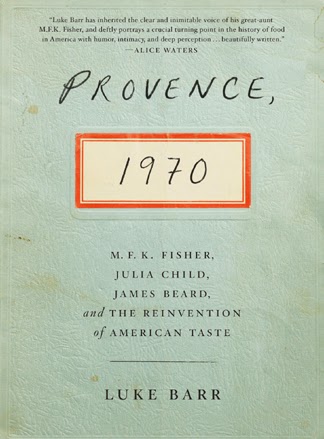
Cooking and Thinking in Provence, 1970


I review a lot of books for my local newspaper. I can’t remember the last one that spoke to me as Provence, 1970 has.

Subitled “M.F.K. Fisher, Julia Child, James Beard, and the Reinvention of American Taste,” the book was written by Luke Barr, an editor at Travel + Leisure and Fisher’s nephew.

(M.F.K. Fisher, in case you haven’t read her, is another great read, perhaps the first American to write culinary essays that were taken seriously by both food lovers and literary critics.)

The book hones in on a few weeks toward the end of 1970 when six food luminaries converged in the South of France. In addition to the three writers in the subtitle, Barr writes about Simone Beck, Julia Child’s friend and the co-author of Child’s pioneering volumes on Mastering the Art of French Cooking; Richard Olney, an American writer and artist who wrote meticulously researched books about traditional French country cooking; and Judith Jones, the influential editor who worked with most of the writers involved.

Jones is the only major character in the book who is still alive. At 89 she is still cooking and writing and is a former judge at my very own hometown’s charity pudding contest, which will return in 2014.

Working from letters, diaries, and memoirs, Barr examines individuals and cultures at a defining moment. Most of his American characters had made their reputations (and built much of their lives) paying tribute to traditional French cuisine. At this point in their lives Child and Fisher in particular were beginning to feel ever so slightly oppressed by the Old World and their old lives in France … and to look forward to a new beginning in the New World.

Barr argues that this moment in food history, the time his characters spent together in Provence late in that year, marked a turning point in the way Americans write about food and consequently in the way we cook. Instead of trying to duplicate classic French modes of food preparation, we began to explore our own culinary possibilities.

Much of the food culture we now take for granted followed—including our renewed interest in local, fresh food; the status of chefs and food writers (although not this food writer yet, alas) as icons of popular culture; our curiosity about new, varied flavors; and what Barr calls the “moral dimension” of cookery in contemporary America.

Barr is careful not to overstate his argument; he doesn’t claim that these encounters in Provence CAUSED the way we cook today. He does convincingly maintain that his characters and their interactions “provide a unique, up-close view of the push and pull of history and personality.”

Provence, 1970 takes the reader on a thought-provoking, delicious tour of a remarkable time, place, and group of people. My favorite moment in the book comes when Julia Child and James Beard are improvising a simple supper in the kitchen at la Pitchoune, the small house built by Child and her husband Paul in rural France.

Julia Child and James Beard at la Pitchoune in December 1970, taken by Paul Child. Used with permission from/courtesy of the Schlesinger Library, Radcliffe Institute, Harvard University
 
For them, as for most of us who love to cook, the preparation of a meal is a balancing act between the knowledge and tradition they have built up over the years in the kitchen and the demands of the unique foodstuffs in front of them. It is an opportunity for creativity and for camaraderie.

I treasure Provence, 1970 for scenes like the one in the Childs’ kitchen and also for its implicit message that change can come at any age. All the main characters are middle aged, ranging from Richard Olney at 43 to James Beard at 67. Yet all are preparing for new chapters in their lives and new chapters in books.

Above all, I love the book for Barr’s sensitivity to the enduring connections that food can forge between people who care for one another and for the preparation and consumption of meals.

His words about his mother near the end of the book speak to the impulse that made me call this blog In Our Grandmothers’ Kitchens.

It was my mother, who died a few years ago, who taught me to cook. And when I make something she made for me, or with me, I feel her presence—not in any literal or even ghostly way, but in the form of an atmospheric shift, an emotional warmth. It is striking how cooking binds us to the past, and to the people we love, even when they’re gone.

As Christmas approaches, I raise a glass and lift a fork to Luke Barr and to the historical figures he brings to life in his book. And of course to my own late mother—and to you and those you love, dear readers.

Taffy and Tinky in 2009
P.S. If you have already purchased Provence, 1970 for a food lover on your list and are looking for other holiday-gift suggestions, a bookstore, Amazon, or I would be more than happy to sell you a copy of my own Pulling Taffy or Pudding Hollow Cookbook. (If you order from me, you may get your copies signed—and you will be supporting THIS middle-aged food writer!)

19 November 2013

The Feast of Love and Hope and Gratitude


This month Americans are observing many anniversaries. Today is the 150th anniversary of Abraham Lincoln’s Gettysburg Address. I long for its eloquence and brevity every time I write—and every time I listen to a political speech.

The 50th anniversary of John F. Kennedy’s assassination in a few days is dominating our television screens now almost as much as it did at the time of that president’s death.

Mulling over it repeatedly, we explore our history, our feelings about our leaders, and the difficulty of ever knowing precisely what happened in the past. (The assassination is an event that has been seen by millions of people and studied by thousands—and yet no one can be 100-percent sure exactly what happened on that day in Dallas.)

The anniversary that interests me most, however, is another Lincoln-related one. In November 1863, a week after writing and reciting the Gettysburg Address, our 16th president led Americans in celebrating our first national day of Thanksgiving.

States and communities had celebrated their own days of Thanksgiving for a couple of centuries by then. It was Lincoln who nationalized the holiday and identified it as the last Thursday in November. (It eventually became the fourth Thursday rather than the last.)

Sarah Josepha Hale

Writer/editor Sarah Josepha Hale had campaigned unsuccessfully by letter for such a day with previous presidents beginning with Zachary Taylor. It took Lincoln’s genius to identify Thanksgiving as a quintessentially American holiday—one that was particularly appropriate to a nation at war.

It is when we are feeling the most stress that we have the greatest need to be grateful. Lincoln realized that a nation at war needed to stop, take stock of its blessings, and express gratitude—perhaps even more than a nation at peace. Indeed, his original proclamation reminded Americans to be particularly mindful of those whose families had been disrupted and/or destroyed by the war.

This spirit lives on in the efforts of a variety of organizations to serve Thanksgiving meals (and bring Thanksgiving cheer) to veterans and their families. It also continues whenever those of us hosting Thanksgiving dinner invite friends, relatives, or strangers to join us for this annual feast of love and hope and gratitude.


You may see Lincoln’s original Thanksgiving proclamation at the National Archives website. And the White House website offers what it calls the “definitive” history of the practice of pardoning a turkey for Thanksgiving. I love the weird American-ness of this tradition; we pardon one turkey a year so that we can feel less guilty about eating millions of its cousins!

I’m not actually posting a Thanksgiving recipe this year—although I refer you to several of them I have posted over the years. Try the hush-puppy pudding … or cranberry upside-down cake … or even simple roasted Brussels sprouts.

Instead I offer this simple seasonal quiche. It uses a vegetable I always overbuy at this time of year, the sweet potato. (I received several with my farm share last week so I was forced to get creative.)

Happy Thanksgiving to you all … and to your families. Don’t forget to open your homes and your hearts to strangers at this time of year.


Sweet Potato Tart

Ingredients:

1 large sweet potato, cut into small pieces and peeled if you want to peel it
extra-virgin olive oil as needed
salt to taste
3 large or 4 medium onions, peeled and thinly sliced
fresh, chopped parsley to taste
four eggs
1/2 cup cream
a dash of Creole seasoning
ounces (more or less) sharp cheddar cheese, grated
1 8-inch pie shell

Instructions:

Preheat the oven to 375 degrees. Pour a tablespoon of oil into a bowl. Stir in salt to taste (start with 1/2 teaspoon). Toss in the pieces of sweet potato.

Place the sweet-potato pieces on a cookie sheet or baking pan, and roast until they are lightly brown around the edges, stirring occasionally. This took me about 1-1/4 hours, but my oven runs cool so it may take you less time.

While the sweet potatoes are cooking, splash oil onto a non-stick frying pan. Place the pan over medium-low heat. Toss in the onion slices.

Cook them slowly, stirring every 5 minutes or so, until they are reduced and softly caramelized. This may take an hour or more. Add a pinch of salt after the first 1/2 hour—and add a little more oil if you need it as you cook. When the onions are finished, stir in the parsley.

Both the onions and the sweet potatoes may be cooked the day before you want to serve your quiche; refrigerate the cooked vegetables until they are needed.

When you are ready to assemble your quiche whisk together the eggs, cream, and Creole seasoning in a bowl.

Place the pie shell in a pie pan. Sprinkle half of the cheese over the pie crust. Top the cheese with the onions and then the sweet potatoes; then pour on the cream/egg custard, and finish with the remaining cheese.

Place the tart (or quiche or whatever you want to call it!) on a rimmed cookie sheet to prevent spillage, and bake it for about 40 minutes, until the custard is set and the top is golden—but the sweet potatoes peeking out are not burning!

Serves 6.

The Tart Halfway Through Assembly

14 October 2013

A Pressing Engagement: Cider and Snickerdoodles


Apples and cider seem to sum up autumn in New England. Bursting with color and flavor, they are doubly precious because they represent the end of the harvest. Winter is coming, and we all know it, but in the meantime we savor the season and its fruit as much as we can.

Last year an ill-time frost made apples scarce here in Massachusetts. This year nature is making up for last year’s dearth with more apples than I can remember seeing in any single fall. An odd tree in my front yard that has never before produced ANYTHING suddenly droops with yellow-pink orbs.

Knowing that I love to make applesauce from a variety of apples, several of my neighbors have invited me to gather fruit from their trees as well as my own. I know that one tree down the road has Gravensteins. Another offers an abundance of Golden Delicious apples. The other trees are mysteries to me. Their fruits vary in color from yellow to such a deep red that the flesh as well as the skin of the apple is imbued with pigment. I don’t care what they’re all called. I just know that I love them!

On Saturday, the actual Columbus Day, the Coopers over on Strawberry Hill here in Hawley hosted their annual cider party. Paul Cooper hauled out his antique cider press, we all brought apples and jugs, and everyone who wanted to went home with fresh-pressed cider. (We also had an opportunity to catch up with neighbors and eat delicious food, but the cider was the main event!)

It can take several people (including advisers!) to press cider. Our host Paul Cooper is in the front right.
This cider is amazingly aromatic, with a deep, rich color that seems even darker than the pretty terrific cider I frequently purchase at local orchards. I am unable to tell you how my own jug of cider tastes; I popped it into the freezer in anticipation of a visit from my brother and his family next weekend. (I’m SUCH a good sister and aunt!)


I can’t really give you a recipe for cider, which just involves pressing apples until they release their lovely juice. (The press looks like a medieval instrument of torture, but it works!) So I’m sharing the recipe for the cookies I brought to Leslie and Paul Cooper’s party, snickerdoodles. Their cinnamony goodness is an ideal accompaniment to fresh-pressed cider.

The recipe came originally from Maureen Schaden-Foster, whose family runs the End of the Commons General Store in Mesopotamia, Ohio. Amish families drive up to the store in buggies to buy nourishing basics, and the store also delivers to several hundred Amish families nearby.

It’s one of the very few cookie recipes I make that call for vegetable shortening instead of butter. You’re welcome to try making it with butter, but I have to warn you that only shortening gives you the dreamy, melt-in-your-mouth consistency a snickerdoodle should have.

Speaking of that consistency, please note that you should really eat these cookies within 24 hours. After that they get a little stale and lose some of their appeal.

So haul out the cider and invite friends over to enjoy this bittersweet season with you.


Amish Snickerdoodles

Ingredients:

2-3/4 cups flour
2 teaspoons cream of tartar
1 teaspoon baking soda
1/2 teaspoon salt
1 cup shortening, softened
1-1/2 cups plus 2 tablespoons sugar
2 large eggs
2 teaspoons cinnamon

Instructions:

Sift together the flour, cream of tartar, baking soda, and salt. Set aside. Cream the shortening, and cream in the 1-1/2 cups sugar. Add the eggs and beat well. Gradually stir the flour mixture into the shortening mixture. Chill the dough for at least 2 hours. (It will have pastry-like consistency; pat it together a bit before chilling.)

When the dough has chilled, preheat the oven to 400 degrees. Combine the 2 tablespoons of sugar with the cinnamon in a small, shallow dish or bowl. Shape the dough into balls the size of walnuts, and roll each ball in the sugar-cinnamon mixture. Bake on ungreased cookie sheets for 8 to 10 minutes. The cookies should be lightly browned but still soft.

Yield: About 4 dozen snickerdoodles.